Blog

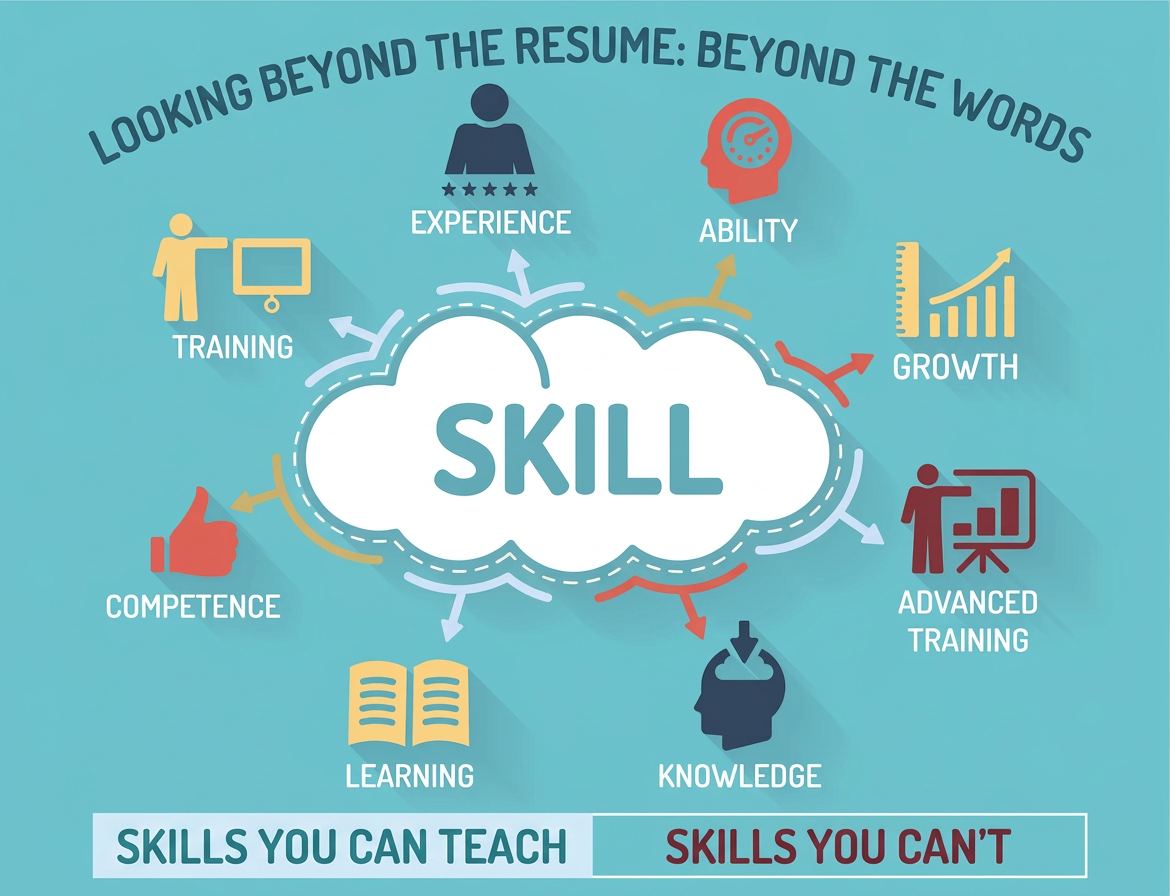
Week 5 – “Skills You Can Teach and Skills You Can’t”: Looking Beyond the Résumé

When hiring employees, experience and technical qualifications are important, but I do not believe they tell the entire story of what someone can bring to an organization. Personally, I would rather hire someone who may not know everything yet but demonstrates strong character, the right attitude, a willingness to learn, and potential for growth than someone with impressive technical qualifications who lacks those qualities. Some skills can be taught through training and experience, while qualities connected to a person’s character and personality can be much more difficult to develop.

Rather than limiting recruiting to people who already perfectly match a traditional job profile, Herrenkohl encourages employers to consider overlooked talent pools (Herrenkohl, 2010). For example, the chapter discusses teachers with strong communication and people skills, college students who can be developed through internships, and individuals whose previous jobs have provided transferable abilities. I think this is important because an A-player may not always look like one on paper at first.

I can relate to this personally as a college graduate entering the workforce. Job searching can be difficult when employers request several years of experience for positions, even when a candidate may have significant potential for growth. A lack of years in a particular position does not necessarily mean someone lacks the ability to learn, contribute, and eventually excel in that position. Current hiring trends appear to recognize this distinction. The National Association of Colleges and Employers reports that nearly 70% of employers responding to its Job Outlook 2026 survey use skills-based hiring. Employers also emphasized students’ ability to connect skills developed through coursework and extracurricular and experiential learning to the workplace (NACE, 2025).

Research also demonstrates why characteristics beyond technical qualifications deserve consideration. A meta-analysis found that conscientiousness was consistently related to job-performance criteria across the occupational groups they studied (Barrick & Mount’s, 1991). Openness to experience was also associated with training proficiency. These findings reinforce the idea that characteristics related to how someone approaches work and learning can matter alongside existing technical abilities.

Ultimately, I believe employers should consider not only what applicants have already accomplished, but also what they have the potential to accomplish. Experience can be gained, procedures can be taught, and technical skills can be developed. When employers recognize transferable skills, character, willingness to learn, and potential, they may discover an A-player they otherwise would have overlooked.

References

Barrick, M. R., & Mount, M. K. (1991). The Big Five personality dimensions and job performance: A meta-analysis. Personnel Psychology, 44(1), 1–26. https://doi.org/10.1111/j.1744-6570.1991.tb00688.x?utm_source=chatgpt.com

Herrenkohl, E. (2010). How to hire A-players: Finding the top people for your team—even if you don’t have a recruiting department. John Wiley & Sons.

National Association of Colleges and Employers. (2025). Job outlook 2026. https://www.naceweb.org/research/reports/job-outlook/2026?utm_source=chatgpt.com


Week 5 – Role Dilemmas: The Right Person for the Right Role

Founding a business does not automatically mean that the founder is the best person for every leadership position within it. While founders bring the original vision, passion, and often significant knowledge to their businesses, I believe roles should ultimately be assigned based on strengths, experience, and what is best for the growth of the company. Leadership decisions should not be driven by ego or status, but by who can currently bring the most value to achieving the mission and vision of the business.

In The Founder’s Dilemmas, Wasserman explains that assigning titles and decision-making authority can become a major source of tension among cofounders (Wasserman, 2013). The CEO title is particularly significant because it carries both symbolic meaning and actual authority. Wasserman cautions against automatically making the person who developed the original idea the CEO. Although that individual may possess the passion and vision necessary to launch the company, another founder may have skills and experience that make them better equipped to lead it. I believe recognizing this requires maturity. If someone else is better suited for a responsibility, allowing that person to take the role is not a loss for the founder. It can actually be a wise decision to relinquish some control for the growth and ultimate benefit of the business.

Research on founder-CEO succession reinforces this idea. In a study of 202 Internet startups, Wasserman found that accomplishing important milestones, including completing product development and securing additional financing, could actually increase the likelihood of founder-CEO succession (Wasserman, 2003). This demonstrates how the leadership needs of a startup can evolve as the business grows. The person who was best equipped to begin the journey may not always be the person best equipped for every stage that follows.

Clearly defining roles is also important. I do not believe role clarity will prevent all conflict because disagreements are inevitable when people work together. However, clarity can establish expectations and reduce unnecessary overlap. In a meta-analysis of 74 independent correlations involving 11,698 participants, it was found that role ambiguity was negatively related to job performance (Tubre & Collins, 2000). This supports the importance of people understanding their responsibilities, even if clearly defined roles cannot eliminate every disagreement.

Ultimately, founders should be willing to ask where they can add the most value rather than which title gives them the most authority. Ego should not determine who leads what. The needs of the business, the abilities of the individuals involved, and the overall mission should guide those decisions. Sometimes strong leadership means stepping forward, but other times it means having enough wisdom to recognize when someone else is better equipped to lead in a particular area.

References

Tubre, T. C., & Collins, J. M. (2000). Jackson and Schuler (1985) revisited: A meta-analysis of the relationships between role ambiguity, role conflict, and job performance. Journal of Management, 26(1), 155–169. https://doi.org/10.1016/S0149-2063(99)00035-5?utm_source=chatgpt.com

Wasserman, N. (2003). Founder-CEO succession and the paradox of entrepreneurial success. Organization Science, 14(2), 149–172. https://doi.org/10.1287/orsc.14.2.149.14995?utm_source=chatgpt.com

Wasserman, N. (2013). The founder’s dilemmas: Anticipating and avoiding the pitfalls that can sink a startup. Princeton University Press.

Week 4 – The Role of Founders: Leading the Team Without Being the Entire Team

As the founder of a business, I believe one of your most important responsibilities is setting the tone for the organization. The founder establishes the vision and purpose, keeps goals at the forefront, and reminds the team what everyone is ultimately working toward. However, being the founder does not mean having to control every aspect of the business. As a company grows, I believe founders have to become comfortable relinquishing some control and trusting the people they have intentionally placed around them.

In How to Hire A-Players, Eric Herrenkohl emphasizes that entrepreneurs who want to build substantial businesses must move away from trying to control everything themselves (Herrenkohl, 2010). Instead, founders should recruit A-players and allow those individuals to use their abilities to help build the business. Herrenkohl also compares effective business leaders to successful coaches: the best coaches recruit talented players, incorporate their individual abilities into the team’s system, and ultimately build a winning team. I believe this is an important distinction because a founder’s responsibility is not to be the entire team but to build, guide, and lead one.

At the same time, relinquishing control does not mean disappearing into the background. I think of leadership similarly to a shepherd leading sheep. A shepherd must be among the sheep to properly guide them. Likewise, founders should remain involved, accessible, and known by their teams. Employees should understand the founder’s vision and know that their leader is available when direction is needed. However, once capable people have been placed in their respective roles, they also need room to use their strengths without being micromanaged.

Research supports this balance. A study of new venture top management teams found that both leadership from the formal leader and shared leadership among team members contributed to understanding new venture performance (Ensley et al., 2006). To me, this demonstrates the value of a founder providing direction while also allowing other capable people to exercise leadership.

Building the right team also requires being strategic about where talent is placed. Organizations should identify positions that have the greatest impact on executing strategy and concentrate talent and resources accordingly (Huselid et al., 2005). This complements Herrenkohl’s argument that leaders should stop simply filling positions and instead view each hire as another piece of the puzzle in building a great, valuable team.

My mom, Bethel Smith, has always said, “Teamwork is the key to great success.” I believe that applies perfectly to entrepreneurship. A founder may begin with the original vision, but growing that vision requires other people. The founder’s role is to keep the mission alive, establish expectations, and guide the team while trusting others to contribute their expertise. Strong founders do not have to control everything to remain effective leaders. Sometimes leadership means building an A-team, giving them room to succeed, and being present enough to keep everyone moving toward the same destination.

References

Ensley, M. D., Hmieleski, K. M., & Pearce, C. L. (2006). The importance of vertical and shared leadership within new venture top management teams: Implications for the performance of startups. The Leadership Quarterly, 17(3), 217–231. https://doi.org/10.1016/j.leaqua.2006.02.002

Herrenkohl, E. (2010). How to hire A-players: Finding the top people for your team—even if you don’t have a recruiting department. John Wiley & Sons.

Huselid, M. A., Beatty, R. W., & Becker, B. E. (2005). “A players” or “A positions”? The strategic logic of workforce management. Harvard Business Review, 83(12), 110–117, 154. PubMed record

Week 4 – Homogeneous Teams: Similar Mission, Different Strengths

When building a team, it may seem natural to surround yourself with people who have similar backgrounds, experiences, and skills. There are certainly benefits to doing so. People who are similar may communicate more easily, establish trust faster, and experience less conflict early on. However, I believe too much similarity can eventually become a weakness. I would rather build a team where everyone shares the same mission but brings different strengths to accomplishing it. Instead of everyone’s abilities overlapping, their individual strengths can enhance one another and create a more well-rounded and stable team.

In The Founder’s Dilemmas, Wasserman explains that founders naturally gravitate toward people who are similar to themselves, a tendency known as homophily (Wasserman, 2013). Homogeneous founding teams can benefit from faster formation, easier communication, and greater initial trust. However, Wasserman also identifies an important long-term risk: when founders have similar functional backgrounds, their human capital can overlap. As a result, the team may have several people who are strong in the same areas while lacking critical skills in others. He contrasts this with teams whose members possess complementary skills and networks that better match the needs of the startup.

This is where I believe variety adds more substance to a team. Different people can look at the same problem and contribute completely different solutions based on their expertise and experiences. Research on entrepreneurial teams found that demographic diversity within new venture teams was positively associated with sales levels and sales growth, supporting the idea (Chandler & Lyon, 2001). Their findings also revealed an important trade-off: teams with greater diversity experienced higher turnover. This reinforces Wasserman’s point that diversity can strengthen a team while simultaneously making team dynamics more challenging.

The answer, therefore, may not simply be to make a team as different as possible. Wasserman makes an important distinction between diversity in areas such as skills, experience, and professional networks and compatibility in “soft” factors such as values, commitment, work styles, and risk tolerance. Similarly, diverse perspectives alone do not guarantee stronger performance; diverse teams need psychological safety so members can communicate openly, contribute their perspectives, and work through differences effectively (Bresman & Edmondson, 2022).

Ultimately, I believe an effective founding team should be united in purpose without being identical in contribution. If everyone brings the same strengths, important weaknesses may remain uncovered. I would rather have people at the table who approach the mission differently but complement one another along the way. To me, the goal is not for every team member to bring the same thing to the table…it is for everyone to bring something valuable that makes the entire table stronger!

References

Bresman, H., & Edmondson, A. C. (2022, March 17). Research: To excel, diverse teams need psychological safety. Harvard Business Review. https://hbr.org/2022/03/research-to-excel-diverse-teams-need-psychological-safety

Chandler, G. N., & Lyon, D. W. (2001). Entrepreneurial teams in new ventures: Composition, turnover and performance. Academy of Management Proceedings, 2001(1). https://doi.org/10.5465/apbpp.2001.6132988

Wasserman, N. (2013). The founder’s dilemmas: Anticipating and avoiding the pitfalls that can sink a startup. Princeton University Press.

Week 3 – Building Social and Financial Capital: The Power of a Strong Network

When building a business, financial capital is undoubtedly important, but I believe social capital can take an entrepreneur further than financial capital alone. Money provides the resources necessary to start and grow a business, but relationships can provide opportunities, knowledge, credibility, guidance, and even access to that money in the first place. For me, networking is of the utmost importance because entrepreneurship is not only about what you have; sometimes, it is also about who you know and who knows and trusts you.

In The Founder’s Dilemmas, Wasserman describes social capital as the durable network of social and professional relationships founders can use to identify and access resources (Wasserman, 2013). His examples demonstrate how professional contacts, former coworkers, classmates, professors, advisors, and other relationships can help entrepreneurs find employees, customers, cofounders, and investors. Wasserman also explains that accumulating one form of capital can create a “virtuous cycle,” as founders with greater social capital can attract additional human and financial capital. This is one reason I view social capital almost like having a large village supporting the business. The more people who know about your business, believe in it, and can vouch for it, the more opportunities that network may create.

Research supports this connection between relationships and financial resources. Dudley (2021) found that social capital increased young firms’ access to outside financing and reduced their reliance on owner equity. The study describes social capital as functioning like “social collateral” in financing arrangements. This demonstrates that social and financial capital do not necessarily operate independently; one can help create access to the other. Additionally, a meta-analysis of 61 independent samples found a positive relationship between entrepreneurs’ social capital and small-firm performance, with network diversity having the strongest positive effect (Stam et al., 2014).

I have also seen the importance of networking while entering the workforce myself. Finding good, higher-paying opportunities is not always based solely on what is written on a résumé. A professional connection, mentor, or someone willing to recommend you can sometimes open a door that your experience alone could not. I believe the same principle applies to entrepreneurship. Networking can connect a founder to someone with experience they lack, an investor they could not otherwise reach, or a mentor who can help them make better use of the financial resources they already have.

Ultimately, entrepreneurs need both social and financial capital. However, if I had to prioritize building one, I would begin with social capital. Financial capital can fund a business, but a strong network can help an entrepreneur find funding, use resources wisely, reach new people, and uncover opportunities they may never have encountered alone. Money is valuable, but having a village of knowledgeable and trustworthy people supporting the vision can be invaluable.

References

Dudley, E. (2021). Social capital and entrepreneurial financing choice. Journal of Corporate Finance, 70, 102068. https://doi.org/10.1016/j.jcorpfin.2021.102068

Stam, W., Arzlanian, S., & Elfring, T. (2014). Social capital of entrepreneurs and small firm performance: A meta-analysis of contextual and methodological moderators. Journal of Business Venturing, 29(1), 152–173. https://doi.org/10.1016/j.jbusvent.2013.01.002

Wasserman, N. (2013). The founder’s dilemmas: Anticipating and avoiding the pitfalls that can sink a startup. Princeton University Press.

Week 2 – Maintaining Control Versus Maximizing Wealth: Building Something Bigger Than Yourself

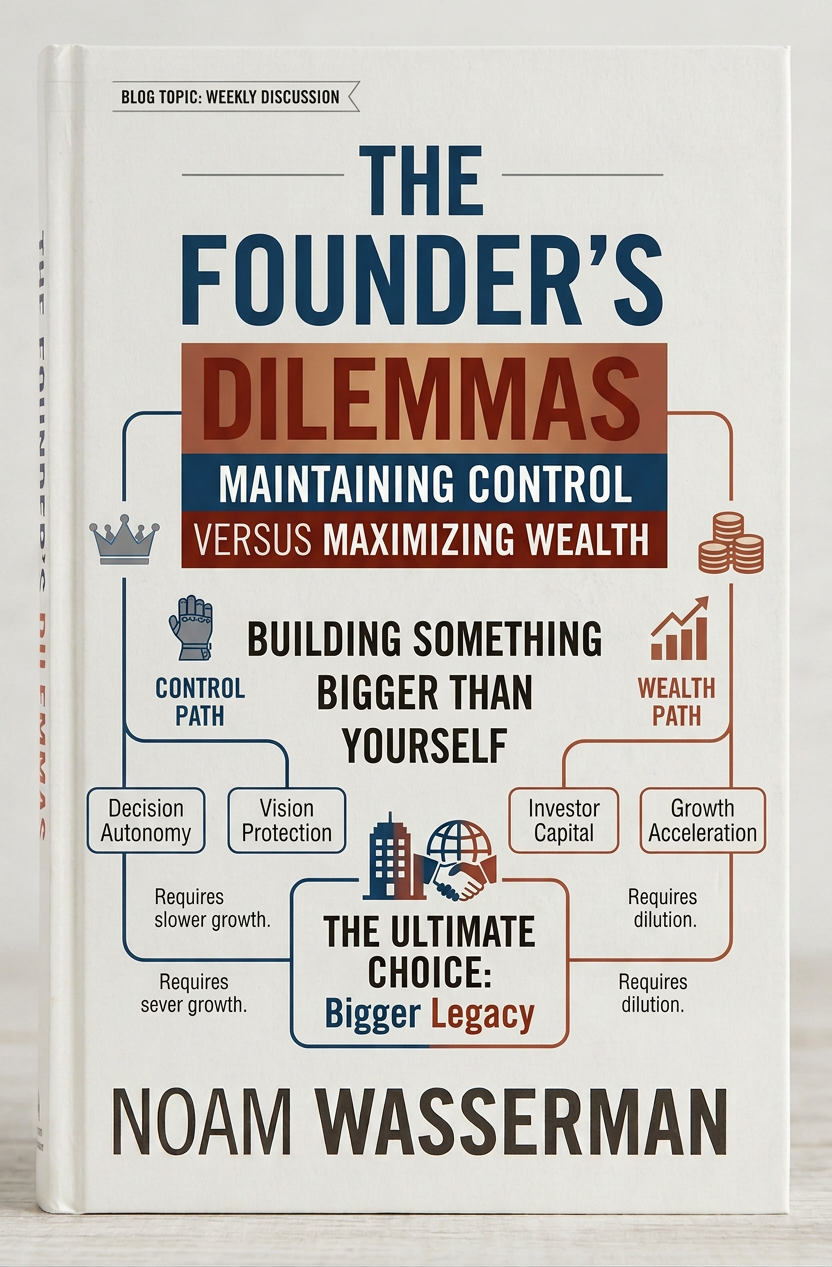
The Founder’s Dilemmas

When starting a business, most entrepreneurs probably envision themselves remaining in control of what they created. After all, it is their vision, their investment, and often their passion that brought the business to life. However, as a business grows, maintaining complete control may actually limit its potential. When considering the choice between maintaining control and maximizing wealth, I would prioritize maximizing wealth. This choice is not simply for the financial gain, but because I believe the ultimate goal should be growth, expansion, and building a business that can continue beyond its founder.

In The Founder’s Dilemmas, Noam Wasserman describes this tension as the choice between being “Rich” and being “King.” The “King” founder maintains control but may lead a smaller and less valuable company, while the “Rich” founder sacrifices some control in exchange for resources that can help the business reach its full potential (Wasserman, 2013). Wasserman’s research provides an interesting perspective on this trade-off. His analysis found that founders who maintained control of both the CEO position and board had equity stakes worth only 52% as much as those of founders who relinquished both. In other words, having a smaller piece of a much larger pie can ultimately be more valuable than maintaining a larger piece of a smaller one.

Additional research strengthens this argument. In a later study involving 6,130 American startups, Wasserman found that each additional level of founder control, such as maintaining the CEO position or board control, was associated with a 17.1% to 22% reduction in a startup’s pre-money valuation (Wasserman, 2017). This does not mean founders bring no value to their businesses. Instead, it shows that growth may eventually require founders to recognize when others can bring resources, expertise, leadership, or perspectives the company needs to move forward.

For me, maximizing wealth also means thinking beyond my own lifetime. I would rather build a company capable of growing and being passed down through generations than maintain complete control only for the business to become stagnant or disappear when I am no longer there to lead it. That requires intentionally training the next generation while also surrounding the business with trustworthy, effective, and reliable leaders. Successful succession involves more than simply assuming the next generation will take over; businesses must consider leadership readiness, governance, and the changing needs of the organization (Di Loreto & Romman, 2020).

Ultimately, I do not believe relinquishing some control means relinquishing the founder’s vision. Sometimes it means trusting other capable people to help expand it. A founder’s greatest accomplishment may not be remaining in control forever, but creating something strong enough to continue without them. To me, that is how a business becomes more than a company…it becomes a legacy.

References

Di Loreto, N., & Romman, O. (2020, January 30). Does your family business have a succession plan? Harvard Business Review. https://hbr.org/2020/01/does-your-family-business-have-a-succession-plan

Wasserman, N. (2013). The founder’s dilemmas: Anticipating and avoiding the pitfalls that can sink a startup. Princeton University Press.

Wasserman, N. (2017). The throne vs. the kingdom: Founder control and value creation in startups. Strategic Management Journal, 38(2), 255–277. https://doi.org/10.1002/smj.2478

ANGEL 31-32: A Life That Reflects Faith, Service, and Impact

Chapters 31 and 32 of Angel by Jason Calacanis served as a thoughtful conclusion to a powerful and practical guide on angel investing. These final chapters shifted from tactics and decisions to something more personal and reflective: finding your identity as an investor and understanding where the journey might ultimately lead. As someone still at the beginning of my entrepreneurial path, these chapters gave me a lot to think about in terms of alignment, sustainability, and legacy.

Chapter 31 really encouraged me to think about what kind of investor I could potentially become. Calacanis makes it clear that there’s no one-size-fits-all approach to angel investing. Some people thrive leading deals, others prefer syndicates, and some find their rhythm in mentoring or focusing on a particular industry. This made me pause and consider my own strengths—my passion for working with youth, my interest in education and social impact, and my value for building meaningful relationships. I don’t have to mimic the Silicon Valley model to be successful; I can lean into my unique perspective and values to shape my own groove as an investor.

In Chapter 32, Calacanis asks a question many people overlook: what’s the long-term vision for your investment journey? This chapter made me think not just about starting, but about sustaining. It’s easy to get caught up in the excitement of launching a business or making your first investment, but what happens ten or twenty years down the line? Will I pivot to a fund? Transition into mentorship or nonprofit work? I don’t have the answers yet, but I appreciated being invited to reflect on it now—before burnout or misalignment creeps in.

These chapters reminded me that success isn’t just about financial returns—it’s about fulfillment and purpose. They reinforced that it’s okay for my entrepreneurial identity to evolve, and that part of the journey is staying grounded in who I am and what I care about. I’m not just building businesses—I’m building a life. And I want that life to reflect faith, service, and impact, no matter what role I’m in.

ANGEL 28-30: Perseverance, Emotional Intelligence, and Long-Term Thinking

Chapters 28 through 30 of Angel by Jason Calacanis offered a dose of reality that I believe every entrepreneur and future investor needs to hear. These chapters focus on the harder, less glamorous side of angel investing—the emotional turbulence, difficult decisions, and long wait for returns. As someone preparing to launch my own ventures and maybe one day even step into the role of investor, this section reminded me that perseverance, emotional intelligence, and long-term thinking are just as critical as financial capital.

In Chapter 28, Calacanis shares how the excitement of the first year can quickly give way to tough decisions. Startups that once looked promising now need more money, and it’s up to you to decide if you’ll bridge the gap or step away. This made me reflect on how hard it can be to let go of something you believed in—especially when people are involved. I appreciated Calacanis’s honesty about the emotional toll, but also his clarity: not every startup is meant to survive, and it’s not unkind to make strategic choices. That’s leadership.

Chapter 29 really spoke to the emotional endurance this space demands. Calacanis encourages readers to maintain balance and perspective, even in the face of setbacks. That resonated with me personally, not just as a businesswoman, but as someone navigating life’s uncertainties with faith. I’ve learned that failure isn’t final and that every disappointment carries a lesson. It was encouraging to read that angel investing isn’t about getting everything right—it’s about staying in the game and noti letting losses shake your confidence or values.

Chapter 30 reframed how I think about success. I used to associate startup success with big money moments, but this chapter helped me understand that most great outcomes happen through acquisition. Calacanis emphasizes the importance of knowing from day one how your startup might be valuable to others down the road. That’s a perspective I want to adopt in my own ventures—thinking not just about how to build something amazing, but how it might fit into a broader system and provide value beyond my vision.

These chapters were a necessary reminder that angel investing—and entrepreneurship—isn’t always easy or linear. But if you can manage the ups and downs, stay emotionally grounded, and think strategically about long-term outcomes, the journey can be absolutely worth it.

ANGEL 25-27: Execution, Relationships, and Communication

Chapters 25 through 27 of Angel by Jason Calacanis provided a powerful reminder that angel investing isn’t just about picking the right startup—it’s about what you do after you say “yes.” These chapters really emphasized the importance of execution, relationship-building, and consistent communication. As an aspiring founder, I found these lessons both practical and thought-provoking.

Chapter 25 outlines the exact steps an investor should take after deciding to invest. From securing legal documents and pro rata rights to wiring funds and scheduling follow-up check-ins, this chapter reminded me of how important it is to be organized and intentional. I liked how Calacanis encourages investors to act professionally and with care—not just for the sake of documentation, but to show the founder that they’re serious about the relationship. As someone who’s working to build trust with others in business, I know how far that kind of thoughtful follow-through can go. It’s not just the money—it’s the effort and consistency that matter.

In Chapter 26, Calacanis flips the perspective and speaks directly to founders. He encourages transparency and mutual respect, reminding founders that angels take on real risk—often before anyone else believes in them. That really resonated with me. I want to be the kind of founder who respects that early faith and doesn’t go quiet when things get hard. The idea that angels should be treated as true partners—not just bank accounts—really aligns with how I view meaningful business relationships.

Chapter 27 drove home the point that consistent communication is everything. I’ve always believed in the value of strong communication, but this chapter made it clear that regular updates aren’t optional—they’re essential. Calacanis explains that silence breeds uncertainty, while a short, structured update can reinforce trust, give investors the chance to help, and create long-term alignment. As someone who values connection and clarity, I see how this discipline could be a game changer—not just for keeping investors informed, but for staying accountable as a founder.

These chapters reminded me that the best investment relationships are built on professionalism, honesty, and consistency. It’s not just about getting the money—it’s about maintaining the trust, energy, and transparency needed to grow something great together.

ANGEL 21-24: It’s About Heart and Strategy On Both Sides Of The Deal

Chapters 21 through 24 of Angel by Jason Calacanis sharpened my understanding of what it truly means to invest with discipline and integrity. These chapters moved away from the emotional and instinctual side of angel investing and leaned into the processes and practices that protect both the investor and founder. As someone who’s an aspiring entrepreneur and potential investor, I found these chapters incredibly grounding.

Chapter 21 highlights the importance of timing, pro rata rights, and understanding valuations. What stuck with me most was the reminder that just because a startup has potential doesn’t mean it’s the right time to invest. Learning to evaluate traction and weigh the risk against the timing of the deal is a skill I want to continue developing. The emphasis on securing pro rata rights also opened my eyes to how easily investors can lose their position in future rounds. I hadn’t realized how strategic those early terms really are.

Chapter 22 discusses the value of writing deal memos. I loved this part because I already journal and reflect in other areas of my life, so applying that same mindset to investing made perfect sense. Calacanis makes it clear that deal memos aren’t just about documentation—they help you be honest with yourself and your reasoning. This reminded me that clarity of thought is just as important as confidence. I want to be someone who doesn’t just follow a gut feeling but can articulate why a decision makes sense.

In Chapter 23, Calacanis talks about the art of saying “no.” I really appreciated this one. Whether you’re an investor, a founder, or just someone navigating relationships, how you decline an opportunity matters. I’ve learned in my own journey that clear and respectful communication goes a long way. Saying “not yet” instead of ghosting or overpromising shows maturity and keeps the door open for future opportunities.

Chapter 24 introduced the due diligence checklist, which was practical and eye-opening. As an entrepreneur, it reminded me of how important transparency and documentation are. If I want someone to invest in my business, I need to be organized, honest, and ready to back up my claims. On the flip side, in the role of an investor, I see the importance of doing my homework. Diligence is protection, not paranoia.

Altogether, these chapters reminded me that angel investing is both a people game and a precision game. It’s about heart and strategy—being thoughtful, careful, and honest on both sides of the deal.