
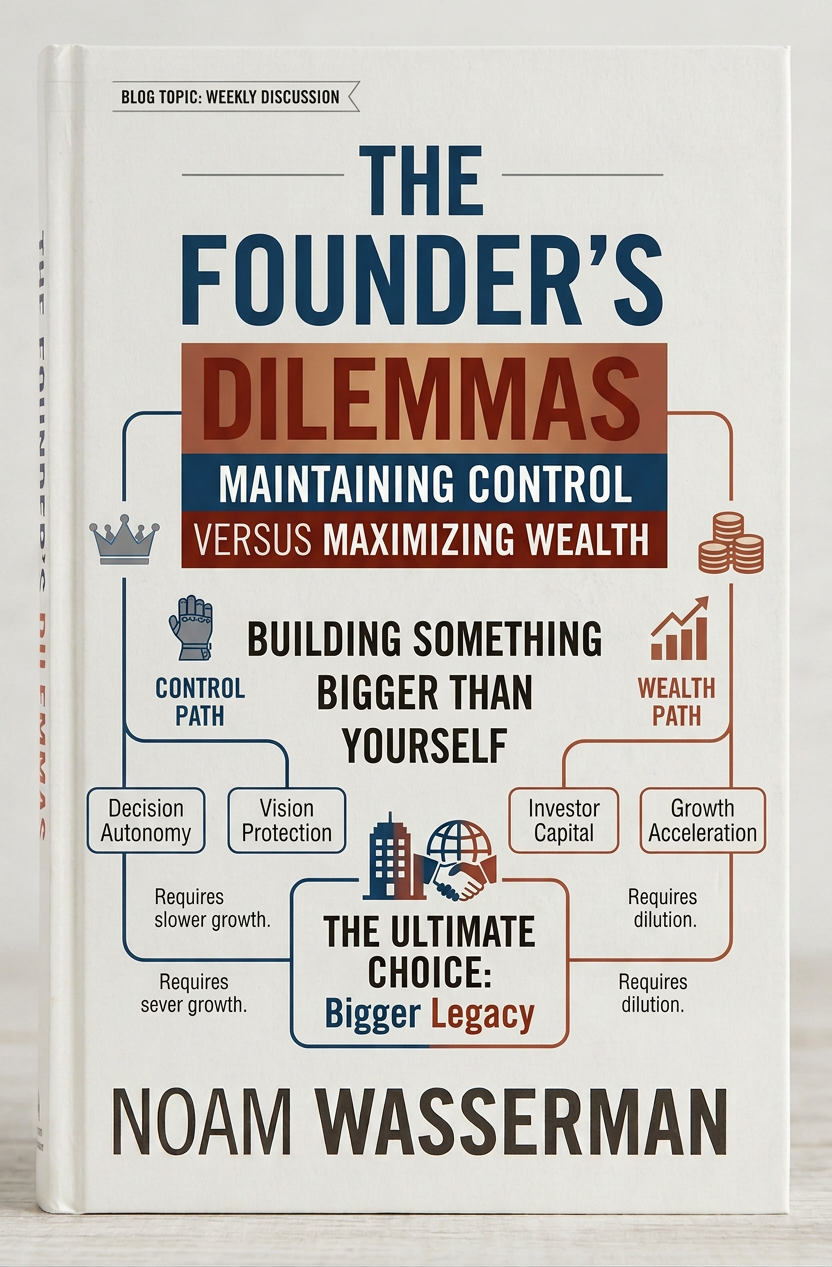
When starting a business, most entrepreneurs probably envision themselves remaining in control of what they created. After all, it is their vision, their investment, and often their passion that brought the business to life. However, as a business grows, maintaining complete control may actually limit its potential. When considering the choice between maintaining control and maximizing wealth, I would prioritize maximizing wealth. This choice is not simply for the financial gain, but because I believe the ultimate goal should be growth, expansion, and building a business that can continue beyond its founder.
In The Founder’s Dilemmas, Noam Wasserman describes this tension as the choice between being “Rich” and being “King.” The “King” founder maintains control but may lead a smaller and less valuable company, while the “Rich” founder sacrifices some control in exchange for resources that can help the business reach its full potential (Wasserman, 2013). Wasserman’s research provides an interesting perspective on this trade-off. His analysis found that founders who maintained control of both the CEO position and board had equity stakes worth only 52% as much as those of founders who relinquished both. In other words, having a smaller piece of a much larger pie can ultimately be more valuable than maintaining a larger piece of a smaller one.
Additional research strengthens this argument. In a later study involving 6,130 American startups, Wasserman found that each additional level of founder control, such as maintaining the CEO position or board control, was associated with a 17.1% to 22% reduction in a startup’s pre-money valuation (Wasserman, 2017). This does not mean founders bring no value to their businesses. Instead, it shows that growth may eventually require founders to recognize when others can bring resources, expertise, leadership, or perspectives the company needs to move forward.
For me, maximizing wealth also means thinking beyond my own lifetime. I would rather build a company capable of growing and being passed down through generations than maintain complete control only for the business to become stagnant or disappear when I am no longer there to lead it. That requires intentionally training the next generation while also surrounding the business with trustworthy, effective, and reliable leaders. Successful succession involves more than simply assuming the next generation will take over; businesses must consider leadership readiness, governance, and the changing needs of the organization (Di Loreto & Romman, 2020).
Ultimately, I do not believe relinquishing some control means relinquishing the founder’s vision. Sometimes it means trusting other capable people to help expand it. A founder’s greatest accomplishment may not be remaining in control forever, but creating something strong enough to continue without them. To me, that is how a business becomes more than a company…it becomes a legacy.
References
Di Loreto, N., & Romman, O. (2020, January 30). Does your family business have a succession plan? Harvard Business Review. https://hbr.org/2020/01/does-your-family-business-have-a-succession-plan
Wasserman, N. (2013). The founder’s dilemmas: Anticipating and avoiding the pitfalls that can sink a startup. Princeton University Press.
Wasserman, N. (2017). The throne vs. the kingdom: Founder control and value creation in startups. Strategic Management Journal, 38(2), 255–277. https://doi.org/10.1002/smj.2478

