
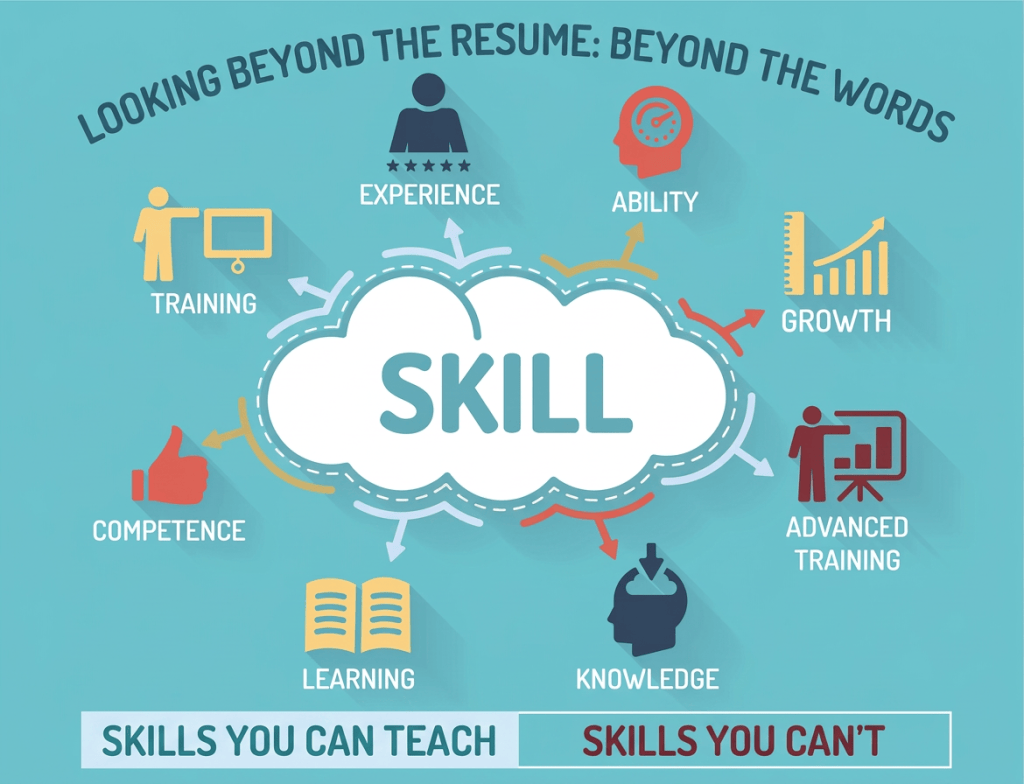
When hiring employees, experience and technical qualifications are important, but I do not believe they tell the entire story of what someone can bring to an organization. Personally, I would rather hire someone who may not know everything yet but demonstrates strong character, the right attitude, a willingness to learn, and potential for growth than someone with impressive technical qualifications who lacks those qualities. Some skills can be taught through training and experience, while qualities connected to a person’s character and personality can be much more difficult to develop.
Rather than limiting recruiting to people who already perfectly match a traditional job profile, Herrenkohl encourages employers to consider overlooked talent pools (Herrenkohl, 2010). For example, the chapter discusses teachers with strong communication and people skills, college students who can be developed through internships, and individuals whose previous jobs have provided transferable abilities. I think this is important because an A-player may not always look like one on paper at first.
I can relate to this personally as a college graduate entering the workforce. Job searching can be difficult when employers request several years of experience for positions, even when a candidate may have significant potential for growth. A lack of years in a particular position does not necessarily mean someone lacks the ability to learn, contribute, and eventually excel in that position. Current hiring trends appear to recognize this distinction. The National Association of Colleges and Employers reports that nearly 70% of employers responding to its Job Outlook 2026 survey use skills-based hiring. Employers also emphasized students’ ability to connect skills developed through coursework and extracurricular and experiential learning to the workplace (NACE, 2025).
Research also demonstrates why characteristics beyond technical qualifications deserve consideration. A meta-analysis found that conscientiousness was consistently related to job-performance criteria across the occupational groups they studied (Barrick & Mount’s, 1991). Openness to experience was also associated with training proficiency. These findings reinforce the idea that characteristics related to how someone approaches work and learning can matter alongside existing technical abilities.
Ultimately, I believe employers should consider not only what applicants have already accomplished, but also what they have the potential to accomplish. Experience can be gained, procedures can be taught, and technical skills can be developed. When employers recognize transferable skills, character, willingness to learn, and potential, they may discover an A-player they otherwise would have overlooked.
References
Barrick, M. R., & Mount, M. K. (1991). The Big Five personality dimensions and job performance: A meta-analysis. Personnel Psychology, 44(1), 1–26. https://doi.org/10.1111/j.1744-6570.1991.tb00688.x
Herrenkohl, E. (2010). How to hire A-players: Finding the top people for your team—even if you don’t have a recruiting department. John Wiley & Sons.
National Association of Colleges and Employers. (2025). Job outlook 2026. https://www.naceweb.org/research/reports/job-outlook/2026


I really liked your point about employers looking at overlooked talent pools rather than only searching for someone who perfectly fits the job description. I think employers can sometimes become so focused on years of experience or specific qualifications that they overlook someone who has transferable skills that could make them successful in the position. Your example about college graduates especially stood out to me because someone may not have several years of professional experience yet, but they could have developed communication, leadership, time management, and problem-solving skills through school, internships, or other experiences.
I also think willingness to learn is extremely important when considering someone’s potential. An applicant who already has the technical skills may seem like the easier choice, but someone who is adaptable, motivated, and willing to accept feedback could potentially become the stronger employee over time. It makes me wonder how employers can improve their hiring process to identify these qualities when they may not be obvious from a resume.
LikeLike
Hi Aamiya,
I think you make a great point, and a great case, for hiring college students here. It’s true that just because someone doesn’t have the relevant experience on paper it doesn’t mean that they cant learn the skills overtime in the position. In fact, I would even argue that for some positions I would rather hire someone who has very little experience and a good work ethic because then I would be able to train them to do the work the way I would want it done, instead of having to re-train someone who’s done similar work, but now they have to do it differently.
It’s been a few years now since I completed my undergrad, but I also remember being fresh out with little work experience and having a hard time getting through to the interview stage of any job application. However, as I do have a pretty good work ethic, I’ve found that even though my application may not have made it to the interview round every time, the jobs that I have interviewed for have resulted in an offer almost every time. I try to keep this experience in mind whenever I’m on a hiring committee – just because someone doesn’t seem impressive on paper, it doesn’t mean that they wouldn’t be a great fit for the job.
LikeLike
Hey Tierney!
Thank you so much for reading my post and sharing your perspective!
I absolutely love your point about being able to train someone according to the company’s expectations rather than having to retrain someone who may already be accustomed to doing things a certain way. I hadn’t necessarily thought about it from that perspective, but I think that’s another great advantage of hiring individuals who are newer to the workforce.
I appreciate you sharing your personal experience as well! I can definitely relate to the challenges of trying to gain experience when so many positions already require you to have it. It’s almost like you need experience to get experience, but how can you gain it if no one is willing to give you an opportunity? That’s why I believe qualities like character, adaptability, work ethic, and a willingness to learn should carry just as much weight in the hiring process, depending on the position.
I also think it’s great that you’ve taken your own experiences and applied them when serving on hiring committees. Sometimes all someone needs is an opportunity to prove what they’re capable of!
Thank you again for adding to the discussion! I really enjoyed hearing your perspective!
LikeLike